[The author is exploring horror movies and horror movie genres and horror-related horror thingies this month in honor of October and Halloween. This is the second in that series, or the third, if you count October Horror #0, which you should … or at least read it.]
Creepy crawlies have a certain, well, creepiness about them that horror filmmakers like to exploit to disturb, scare, or just plain gross out the audience. This creepy-crawlie sub-genre of horror preys upon our fear of spiders, worms, and insects, many of which are made giant size in order to up the creep factor.
Spiders are a perennial favorite. One of the scariest spider-oriented movies that I can remember from a youth spent hanging out in front of the TV is “Kingdom of the Spiders” (1977), where a town is overrun by deadly not-giant-but-really-big web-spinning tarantulas. Never mind that tarantulas aren’t web-builders, the movie freaked this arachnophobe out.
Speaking of arachnophobia (which is, if you were wondering, an unreasonable — or, I’d argue, quite reasonable — fear of spiders), there was the John-Goodman-playing-an-exterminator movie “Arachnophobia” (1990), about a small community threatened by a plague of spiders made into killers by the introduction of a violent South American species of, erm, web-spinning tarantula.
If that isn’t enough to get your arachnid fix, then there’s 2002’s “Eight-Legged Freaks”: giant, jumping, spiders with very big fangs. I’m shuddering just typing such a thing. And although it isn’t spiders-threatening-civilization-as-we-know-it, “The Incredible Shrinking Man” (1957) is frightening enough, pitting the height-challenged protagonist of the title against a common house spider (I shudder at the idea that there are such things as ‘common’ house spiders) armed only with a sewing needle.
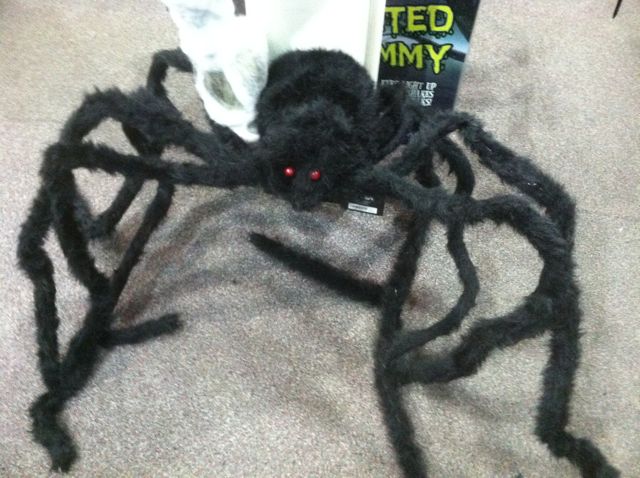
This spider very likely thinks you're a fly.
If you want your spiders with a bit more fun than fang, I recommend the Mystery Science Theater 3000 version of “The Giant Spider Invasion” (1997/1975) where the giant spider of the title is actually an animatronic beastie duct-taped (as far as I can tell) over a 1970s VW Bug, like the world’s ickiest parade float. And while you’re enjoying the movie-riffing of the MST3K gang, pull out “Horrors of Spider Island” (1999/1962) which, possibly playing on the mispronunciations possible with that title, puts a boatload of prostitutes (exotic dancers? hopeful starlets-to-be? baristas?) on an island with a spider-man. And not Tobey Maguire or that guy that will be playing Spider-man in the reboot of the superhero franchise, either, but an oozy, fanged, floppy-armed mutant.
Separate from spiders, insects have their share of screen time, too. Again, don’t confuse insects with spiders, or spiders with insects, or any other permutation thereof. Spiders aren’t insects. Your entomological fun fact of the day: insects have six-legs, spiders get two extra, the better to hold you down when you’ve been shrunken to the size of a salt shaker by cosmic rays.
Anyway, in the insects-that-want-to-kill-you-subgenre, cockroaches keep coming back even after you step on them. There’s Franz Kafka’s “Metamorphosis,” wherein a layabout kid turns into a giant cockroach overnight. Much hilarity (or depressing Kafkaesque social commentary) ensues. There’s also “Mimic,” an excellent horror movie about cockroaches that have evolved to the size of humans and can mimic the human form (if you see them in bad lighting after a few beers). Much hilarity (or cockroaches chomping on humans with virtually no social commentary) ensues.
There’s also the Samuel Z. Arkoff’s (he of the cheap, late-night made-for-tv fright fest movies of the 70s) environment-gone-wrong flick, “Frogs” (1972). “Frogs,” although titled “Frogs,” doesn’t skimp on nasties, even if they don’t happen to be amphibians. There’s snakes, worms, and, if I remember right, cockroaches. Okay, maybe there’s not cockroaches, but there is hilarity (if you count the fact that it’s Sam Elliott’s first starring role) and social commentary, too, since the critters decide (perhaps by committee) to attack humans because said critters are upset about a chemical plant upstream dumping toxic waste into their river. The movie starts off with a touching-in-that-they’re-trying-to-recreate-the-emotional-impact-of-that-Native-American-chief-crying-a-single-tear-because-of-pollution-public-service-commercial-of-the-1970s scene where Sam Elliott’s character is paddling down the river in a canoe taking pictures of trash and dead fish. He’s Sam Elliott, so he doesn’t cry, but he does get angry. He also wears very tight jeans.
Not to be outdone by the beasties with legs, the Squirmy-Thing Union went into collective bargaining with Hollywood to give us such stomach-clenchers as “Slugs,” (1987), “Tremors” (1990) and “Slither” (2006). Oh, and, of course, “Frogs” (still 1972).
The first one, which I showed at a Halloween Party back in the 90s, was a crowd favorite. I came in from re-filling the aquarium with Bug Juice (1 liter of vodka to 1 gallon of fruit punch, no actual bugs harmed during preparation) and found two-thirds of my partygoers sprawled out on the living room floor watching this atrocious movie wherein slugs inundate a home (or possibly a whole town — I have no idea) and are menacing a family who have to take refuge on top of beds, tables, and other assorted furniture. I haven’t watched this awful-sounding piece of dreck, but, hey, can fifteen drunken people at a Halloween party be wrong?
“Tremors,” although having far more humor than horror, also has just enough tension (and devoured protagonists) to make it into this list. Kevin Bacon leads (poorly) a group of small town oddballs who must try to survive in the face of an attack on their tiny community by burrowing worms of the “Dune” (1984; not a horror movie) sort — giant, vibration-seeking, and hungry.
Which reminds me of another science fiction movie with a lot of horror in it: “Screamers.” “Screamers” has burrowing killbot worms that make a lot of noise right before they kill you.
Soooo, there’s that.
Meanwhile, back with the squishy critters and “Slither,” we have alien worms that infect people and make them into alien-worm-breeding hosts. It stars Nathan Fillion (of “Buffy the Vampire Slayer,” “Firefly,” and “Doctor Horrible’s Sing-along-Blog”) and is a horror parody sometimes, although at other times it takes itself too seriously. Anyway, it’s in the “Lake Placid” school of horror-humor.
Ah, “Lake Placid” (1999): Giant, killer alligators (or possibly crocodiles; I can never tell them apart) and a slightly psychotic Betty White. What more do you really need in a giant, killer alligator (or possibly crocodile) movie? 1980’s “Alligator,” while scary, doesn’t have Betty White, so that’s a no go; and 2007’s “Primeval” has too many genocidal warlords to have much in the way of fun-ness. Nope, go with “Lake Placid.”
But I digress.
“Frogs”: snakes, worms, and killer tadpoles. Okay, maybe the tadpoles are just angry, but when they grow up, they’ll be angry AND human-killers.
The creepy-crawly trend even spills over into supposedly non-horror fare as the reality psuedo-game show “Fear Factor” and the reality psuedo-prank show “Scare Tactics,” where contestants (or innocent passersby) are often confronted with tanks filled with squirming worms, crawling spiders, antennae-waving insects, and writhing maggots.
Sometimes they’re even required to lay down among all these ickies, or even eat them.
Yummy.
What you don’t normally see on those shows are people being creeped out by bunnies. But never fear, there are movies out there that can sate your desire for deadly furballs. We’ll take a look at those next time.
Until then, keep in mind that slugs shrivel up when you pour salt on them, so keep those condiments handy; they’re not just for popcorn anymore.
[Next time: When Animals Attack, Then Eat You, Then Attack Some More!]


When Animals Attack, Then Eat You, Then Attack Again (October Horror #3)
[The author is examining horror movies and horror movie tropes and possibly horror movie-themed t-shirts and coffee mugs during the month of October. This is the fourth column in the series, even though it says #3 up in the title. Get over it.]
One of the backbone thematic questions horror movies ask is this: what would happen if nature had had enough of humans screwing things up and decided to sic its critters on us?
There was a trend in the 1970s and 1980s of making horror movies that were also ecological morality tales. On the surface, this doesn’t sound like it’d be a whole lot of fun. “Morality Tale” gives out much the same vibe as having the preacher over to talk to the kids about why they shouldn’t be looking at pornography on the internet.
However, when you combine the morality (“We’re screwing up the environment and should really do something to fix that”) with giant, mutated beavers, such as the much-bigger-and-angrier-than-a-normal-beaver one found in 1979’s “Prophecy,” then things get a lot more entertaining. Nothing like giant, mutant beavers menacing some campers to convince you that logging companies should be more careful about how much toxic waste they dump into the river. Heck, before I saw this movie, I didn’t even know that logging companies produced toxic waste. Deforestation, sure, but giant-mutant-killer-angry-really-nasty beavers? Nope.
Exploring a similar toxic waste theme is the Samuel Z. Arkoff “Frogs” (Still 1972 — we’ve gone over this in a previous column, quit bugging me about it). Our protagonist, Sam Elliott (in his first starring movie role — “Card Player #2 in “Butch Cassidy and the Sundance Kid” doesn’t count), is on a canoe-about, taking evocative pictures of trash and other pollutants fouling up the river. He soon finds himself on an island owned by Mr. Let’s-Dump-Toxic-Waste-From-the-Plant-Straight-Into-the-River Man himself. While Sam tries to convince Mr. LDTWFtPSItR Man into changing his evil ways, members of the birthday party going on start being knocked off one-by-one by mutant, killer frogs. Well, actually, the frogs in the movie don’t do much more than hop around and croak ominously, but they ARE very ominous, and it’s obvious that they’re the masterminds goading the snakes and bugs and, erm, more snakes into doing the killing for them.
Anyway, lesson learned: don’t dump your toxic waste straight into the river, at least not without investing in a few frog spears first.
The frogs in the movie weren't quite big enough to eat you, but that didn't stop the filmmakers from giving it a go.
And if you thought you were safe just because you were surrounded by cute, hopefully-not-killer bunnies, well, watch out, buddy, because 1972’s “Night of the Lepus” (also called “Rabbits”) shows us that EVERYTHING in nature is out to get us. At least in “Night of the Lepus” there isn’t toxic waste dumping. In fact, the characters are trying to be ecologically friendly by dealing with a rabbit infestation not by spraying the fluffy little fellas with cyanide, but by messing up their breeding cycle with hormones. Ahh, hormones. Hilarity — and rabbits the size of dump trucks eating people — ensues.
Also, rabbit-wise, we don’t know for sure that “Monty Python and the Holy Grail”‘s (1974) viscious Rabbit of Caerbannog wasn’t created by some logger pouring poisonous log slurry into pristine natural springs.
And I have no idea what created the shark-toothed rabbit of 2010’s “Primal,” but there it was, all toothy and bitey and mean as a bunny scorned by his hormonally-neutered significant other.
What we see in these ecologically-minded horror narratives is a reflection of the fears of the time. Or at least a reflection of the fears we as a society and a species have that we may be, pardon my Midwestern, crapping in the same place we eat.
After the creation of the atom bomb in the 40s, we get a slew of mutant animal movies created by radiation. Even excluding the Godzilla (and other Giant Monster movies) of the Japanese, there was still plenty of radiation mayhem to go around. In “Them” (1954), it was giant ants. In the “Beast from 20,000 Fathoms” it was a stop-action dinosaur (hey, dinosaurs are people … er, animals … too). It was a praying mantis in “The Deadly Mantis” (1954), and, well, the list goes on.
In the 70s, it was all about industry poisoning the environment, as we’ve already seen. Later, genetic manipulation takes the stage as the Meddling With Things That Should Not Be Meddled With trope. “Deep Blue Sea” (1999) is one of my favorites of these, what with its nearly-amphibious super-smart sharks and Samuel L. Jackson’s rousing Let’s-Work-Together-Here-People morale-boosting speech. But we can’t forget the genetically-tampered-with flying piranhas of 1981’s “Piranha II”. Mmm, flying piranhas.
Because regular piranha just aren't scary enough.
And, of course, there’s “Jurassic Park.” Dinosaurs re-created by taking DNA found in ancient mosquitos locked in amber and infusing it into frog eggs — the frogs finally get to have teeth and don’t have to depend on the snakes to do the wet work.
In the Oughts, nature started to do away with the intermediaries, too. In M. Night Shyamalan’s mess of a movie, “The Happening” its the very embodiment of nature — the plant life — that’s out to remove the plague of humanity from the surface of the planet, via a self-preservation-removing pheromone attack. Fortunately, Zooey Deschanel lives. Mmmm, Zooey Deschanel.
However, there was still plenty of genetic tampering going on. “Black Sheep” (2006 — not the 1996 Chris Farley movie) takes us to scenic New Zealand and to a sheep ranch where the sheep have acquired a taste for blood thanks to hormonal manipulation. Also, if they bite you and you don’t die, you turn into a, erm, sheepotaur. Or weresheep or something. 2005’s “Isolation” does much the same thing, but with cows. It’s also considerably scarier; although you might be more scared of the ickiness of farm life than of the small, Alien-like killer cow fetuses crawling about. I can’t advise eating anything, even popcorn, while watching the scene where the vet has her arm up to the elbow in this pregnant cow’s … well, best leave that to the late-night viewing.
Moving on. Now, in the Post-Oughts, barring zombies and possibly sparkly vampires, the trend of mutant monsters in horror seems to be moving away from radiation, genetic mutation, and DNA tampering to Things-Found-in-Places-We-Shouldn’t-Have-Gone. Mostly, the things found there are mutant or hyper-evolved humans, rather than groddy Stan Winston special-effects animals. That’s the case in the excellent spelunking-gone-bad movie “The Descent” (2005) and in the aforementioned “Primal,” as well. This may be because humans are easier to get along with as actors than animals are (Russell Crowe excepted, of course), or it may be because our fears are turning away from what nature is going to do to us when she gets peeved enough, since there’s not much we can do about that anymore, and more toward the depths to which humans can sink. Since many of these movies deal with going into caves or ancient ruins (“The Cave” (2005), “The Ruins” (2008)), they evoke a metaphor of us “descending” into the darkest places of our psyches.
Still, there is that shark-toothed rabbit in “Primal.” Maybe the beasties will be making a comeback.
Share this: