I did not vote for lower gas and egg prices; I voted for empathy, human kindness, and human rights. For those who overlooked the dearth of the latter in favor of the pursuit of the former, I can only shrug. You believe you have done the right thing. I don’t understand it. I have tried very hard to understand it ever since 2016, and I have failed. So I shrug.
Am I concerned that Trump, unburdened by even the minimal number of advisors who served as something of a brake last time, will run the country into an economic, political, world stage pit of horrors? Yes, of course. I knew people in D.C. last time and heard how getting anything done was nearly impossible due to direct choices made by Trump and his administration. And I look at the state of the world and have nearly zero faith that Trump can do anything but make things worse.
But those are not my largest concerns. There ARE still checks and balances, teetering as they may be. I DO have hope that we’ll come out the other side of all this still stumbling along as a country.
What I AM concerned about are my friends–the ones I currently have and the ones I do not yet have and the ones that I will never know. I am concerned, of course, about Federal policies that will make their lives more difficult, or impossible, or make them out to be the ‘enemy’ (from within or without, does it matter?). But, hey, I saw some hope at the state level as far as passage of various bits of legislature goes (Missouri? Who knew?). Still troubling? Yes. Worth fighting for at the local and state level? Yes.
That said, here’s what I AM most concerned about: there is a certain faction of the far right–they are not a small faction, unfortunately, and they aren’t even a ‘faction’, mostly; they are individuals and small groups–who look at Trump and say, “Yeeeesssss…he’s speaking my language!” and they look at a large section of the voting populace voting for Trump and say, “Yeeeeessss…they agree with me,” even if that large section of voting populace really only wanted (thought they wanted? I don’t know; still trying to understand, I suppose) better prices at the grocery store and at the pump. This faction looks at who we voted in for President, the rhetoric and the animosity and the hate espoused by certain very vocal proponents of him, and they will feel emboldened. They will feel empowered. They will feel that they are warriors for justice on the side of righteousness, and they will feel it is their duty and their place to bully, harass, and even kill those who have been ostracized by our political (and by extension ethical and moral) choices.
That’s what I’m concerned about: that the bullies will feel empowered by seeing that we have elected one of their own (is he? Or is he just posturing? Does it matter? In this case, only perception matters) and feel that they and their beliefs have a mandate.
So, yeah, I’ll be fine. Heck, I may even wind up better off if all the ‘I’m voting for economic reasons’ people turn out to be right. I don’t think they will, for a variety of reasons, but hey, maybe.
Yet here’s the thing: even if guaranteed to be true, I’d give that over in a heartbeat to keep my friends safe. Of course I would.
What does this all boil down to, other than my expression of an exasperated and wounded sigh sent whirling out into the void? It is this: I hope you, whoever you are and whomever you voted for, will, if you see someone getting harassed, threatened, or otherwise exposed to harm, physical or psychological, will (please, please, please) step in. Maybe you don’t ‘believe’ in their lifestyle, or fully trust their ethnicity, their perceived nationality or, heck, their political views. But still, I hope that you will, if you see something happening, use YOUR place of privilege and acceptance by society, if you have such, to say, “Hey, no. Back off.” Stand up for empathy, kindness, and human rights. Please.
And then maybe, maybe, maybe just maybe I’ll actually believe that America can be great again.
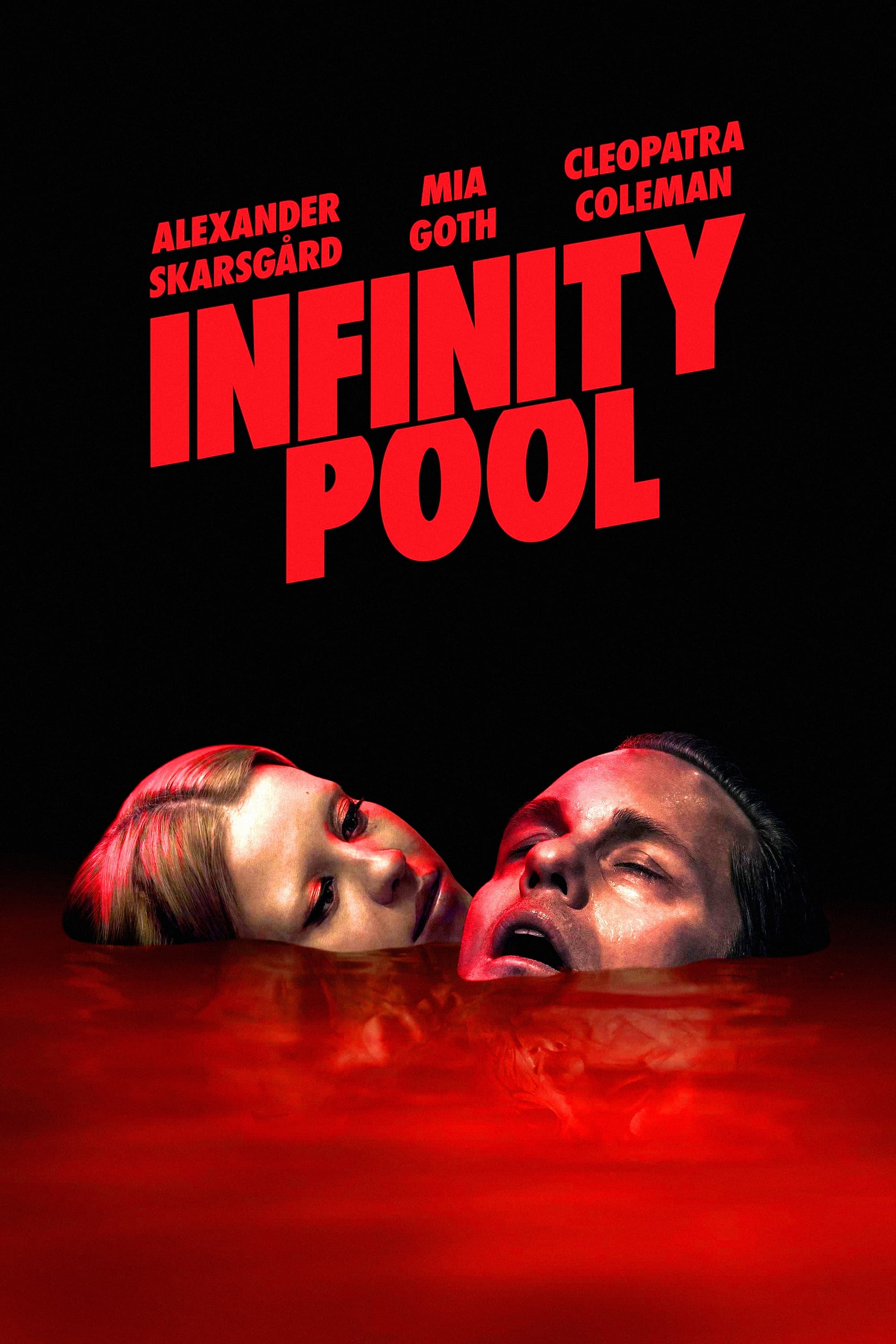
The following is an analysis of 2023’s Infinity Pool (dir. Brandon Cronenberg). As such, spoilers abound. If you haven’t seen Infinity Pool, go out and do so before reading this essay.
I am a proponent of a philosophy of literary criticism that posits that, regardless of what the creator may have intended, it is the ‘text’ that matters, whether that text be the written word, a painting, a photograph, or a film or tv show. Any interpretation of that text, then, is valid if and only if two criteria can be met: an interpretation must be backed up by the text and not contradicted by the text.
First, the interpretation must be backed up by the text. If you want to argue that Stephen King’s Christine is a pan of the airline industry, you’re going to have a hard time convincing me, as there is no mention whatsoever of the airline industry in the story. To make the argument that it’s a panning of the obsessive car-culture of America, however, could possibly be backed up by the ‘text’ of both the novel and the movie.
Second, the interpretation must not be contradicted by the text. In the above example, you can’t make the argument that Christine has nothing to do with the coming-of-age theme because all the elements of that theme are right there in the text: the awkwardness of teenagerhood, the difficulties of a burgeoning realization of one’s own sexuality, dealing with the loss of innocence and youth, and so on.
If an interpretation, including the author’s, meets these two requirements, then, it is a valid interpretation. If it doesn’t, then, well, it isn’t. And I’ll repeat: including the author’s. This last is an important caveat, since we often go to the author to find out What A Story Means. Sometimes they won’t tell us. Sometimes they will.
Unfortunately, when they do, this has a tendency to curtail our own explorations of what a piece might be about, and what that piece might say about ourselves and about the world.
I bring all of this up because the movie Infinity Pool (2023), written and directed by Brandon Cronenberg, son of horror maestro David Cronenberg (The Fly, Videodrome, Shivers), is a very ambiguous movie. It includes sci-fi scenes accepted by the characters in the story that approaches magical realism, plus an ending that leaves us wondering what is real, what is in the mind of our protagonist, and, well, what the heck just happened. Cronenberg himself is reported to have based the script on experiences he had during unsatisfying vacations, and on an idea he had about killing clones (https://www.latimes.com/entertainment-arts/movies/story/2023-01-22/infinity-pool-sundance-film-festival-brandon-cronenberg), but if we just see the story of Infinity Pool as What Happens When We Get Bored on Vacation, we’re missing more subtle opportunities for analysis.
Briefly, Infinity Pool is about James Foster (Alexander Skarsgard), a writer of questionable skill and very questionable success, who is on vacation to an exotic (and fictional) locale with his wealthy wife (Cleopatra Coleman). Gripped with a bit of ennui, James joins another couple, the Bauers (played by Mia Goth and Jalil Lespert), on a joyride outside of the compound where tourists are supposed to remain secluded. After a day of drinking, James winds up driving the car back to the compound at night, hitting and killing a pedestrian as the car’s lights fail.
The authorities track James down and take him into the local police station, where he discovers that the country’s laws are quite draconian and quite zero tolerance: he is to be executed by being stabbed by the young son of the man he killed. However, there’s a way out. With enough money, James can have a clone made of himself, one who will have his memories and believe himself to be guilty of the crime…and that clone can take the punishment meant for the ‘original’.
James, of course, takes this option.
Afterward, he discovers that the Bauers and their friends already knew about this caveat, and they take advantage of it on a regular basis. Soon, these tourists are committing crimes left and right, and all they need in order to get out of paying for their offenses is to literally pay for their offenses. With enough money, it doesn’t matter what they do, their clones will take the punishment for them.
At this point in the film, after Mia Goth’s Gabi Bauer gives James hallucinatory drugs, and he has managed to alienate his wife, Em, we are given a dream-like sequence of events where we discover that the Bauers and their friends have either been puppetting James for their own amusement, or doing so in order to break him out of the funk that hasgripped him in order to help him find his real self–or possibly both.
At the end of the film, the Bauers and the others have left the island, acting as if nothing particularly important has happened at all, while James is seen sitting on a beach chair in the rain at the now-empty, off-season resort, staring into the far distance while being soaked by the rain.
Cut to credits.
There’s a lot going on in the two-hour runtime of Infinity Pool, the name of which is both a reference to the so-called infinity pools of high-end resorts which appear, as you’re in them, to stretch off into the ocean itself and thus to ‘infinity’, as well as to a tank filled with a viscous red liquid that is used to create clone after clone after clone (an infinity’s worth, perhaps) of James and other wealthy tourists.
However, putting aside (but not ignoring) the sci-fi aspects of the movie, Infinity Pool can be seen as an examination of the difference between the ‘tourist’ and the ‘traveler’.
The tourist, in broad terms, travels to a foreign locale; however, once there, they immerse themselves not in the local culture, but rather in the familiar comforts to be found in, for instance, resorts that cater to their every whim, allowing the tourist to enjoy all the amenities of home, while also giving them the ability to say that they’ve journeyedto this exotic place.
The traveler, on the other hand, though unable to fully immerse themself in local culture (that would make them an immigrant or an ex-pat, perhaps–subjects for a different essay), still attempts to do so as much as possible, mingling with the local people, eating the local foods, avoiding the ‘touristy’ places.
The tourist is not often (at least in popular conception) fundamentally changed as a person by their experience visiting a foreign land. The traveler, however, often is. Travel, we believe, can show us our true selves and reveal to us an ability to grow and become more a part of the wide, wide world we live in, as well as to develop empathy for the many, many others who inhabit the world we all share. Travel, in these terms, can become almost a religious experience.
James starts off as a tourist. He is confined to a resort that caters to others like him, and so his only real engagement with the local culture is the scenery, and even that is manicured and curated to be pleasing to the eye. The resort’s representation of the locale comes across as artificial in the same way that a dinner show of ‘native’ dancers performing ‘ceremonial dances’ comes across as artificial, even if performed by members of the culture in question.
James’ ennui, driven by his self-perceived failure as a writer, finds no alleviation from the pleasures of the resort. What can this artificial beauty and luxury mean if you feel that you, yourself are inauthentic and artificial?
So when he is given the opportunity to experience something that isn’t artificial, urged on by a beautiful woman who seems to see and appreciate his worth as a writer, James of course takes it.
We can then see the events of the rest of the movie as metaphorical (as well as literal–I don’t wish to reduce the sci-fi elements of the film to pure metaphor), showing to us the difference between the tourist and the traveler.
The Bauers and their friends remain tourists throughout: using their wealth and their privilege to escape consequences for their impact on the the island where, ostensibly, they are guests. Instead, they treat the land, the people, and the culture as a playground in which they can sate their any whim or desire and be unchanged–unaffected in any way–by it.
But James cannot. Each clone of himself represents something important within himself that he both is able to slough off as well as learn from, even as he sloughs off their very literal artificiality. We see the importance these parts of himself have to James as he packs the ashes of each one carefully into his luggage, a reminder that each was not merely a duplicate, not entirely artificial, but also him, a part of self.
The first clone–the one that takes the fall for James’ accidental killing of the local man–might be seen to represent his own self-loathing, or perhaps James’ bowing to the inevitability of fate; he didn’t mean to kill the man on the road, but it was his choices that set up circumstances such that the death of the man was almost inevitable, in the same way that his choices have brought him to this place in life where he feels like, at best, a fraud, or, at worst, a failure.
The second clone–who is executed for the purposeful killing of a local–can be seen to represent the hedonistic qualities that James has embraced in order to try and forget himself through the safety net of his wife’s money, his own descent into embracing the consequenceless power that money brings.
And the third, a clone created by Gabi Bauer and the others so that James must either kill or be killed, can be seen to represent his own internal rage at the world and at himself.
As Gabi smears the blood of this final slain clone on her breast so that James can suckle, the moment becomes a rebirth for him: a birthing into a place where he can now become who or whatever he really is as he both leaves behind and learns from facing these representations of self.
But on the bus headed to the airport, James has another epiphanal moment: the others have obviously not been affected by their time here in this foreign land in the way that he has been. Instead, they talk of mundane things and of things that must be done when they return home.
This is the conundrum of the tourist vs the traveler. The tourist, after the trip, returns to their lives unchanged, unaffected, and without personal growth. The traveler, though, has a difficult, if not impossible, task of trying to return to a life that no longer seems to make any sense, and certainly doesn’t seem to hold the importance that it once did, not after they have seen what they have seen, experienced what they have experienced.
When we see James sitting on that beach chair at the empty resort, drenched in the first rains of the rainy season, we are left wondering, as James’ thousand-yard stare seems to imply that he is wondering: What does it all mean?
Here’s a factoid about me: when I’m on a roll, I can produce about 1000 words an hour. I once wrote a whole novel (75000 words-ish) in ten days. It was Thanksgiving holiday and I took a couple of days off, but essentially I was knocking out 10,000 words a day during that time. And I wound up with a novel I liked, too–so it was quantity AND quality. Not saying it couldn’t use some editing, but it was in pretty good shape, say self so I do.
That novel was a one-off, but producing 1-3k words per day isn’t outside the realm of my writing capability. That said, I rarely do it. Why? Possibly because I’m lazy. But more likely because I’m easily distracted (SEE: the name of this blog). This became especially true during the years of High Pandemic (I’ll write about this means of designating eras of COVID in another essay, maybe). During that time, when I wasn’t working on the podcast (The Gothic Podcast, wherever you catch your pods), I was scrolling, scrolling, scrolling. Should I have been writing, writing, writing? Almost certainly. But a lot of us didn’t do what we ‘should’ have been doing during those times. And that’s okay.
And it’s certainly okay not to type 1-3k words per day.
But if you count yourself a writer, should you have SOME quota of words-per-day? Plenty of advice out there would tell you to do so. It’s in nearly every writerly-advice book there is. When I’m writing short stories, though, I don’t have a quota. Short stories burn hot and bright and fast in my brain, and I have to get them out on those waiting blank surfaces of the page as quickly as I can. When I’m writing short stories, I’d prefer not to tidy up the house, cook breakfast (or lunch or supper), take out the trash, answer the phone, check my e-mail … all I want to do is write and get it down. Get the story … out there. Five thousand words in a day? Great! Done! Time to edit.
In the past few years, I’ve had a few of my many finished short stories published (check out the link, er, somewhere), but I haven’t written a new novel in … years (we’re not talking about editing the ones I’ve already written, or the trudging, terrible work of getting them out to potential agents and editors — that’s a task that requires a much different set of skills than writing the story in the first place).
So, lately, I’ve been wanting to create something new in the long form of the novel. But I had to figure out how to, y’know, do that. My brain has become wired to scrolling, to binge-watching TV, to doing something outside of the house (hiking, kayaking, whatever). Anything except for writing. Sometimes a short story will rear up from the briars and demand to be stalked, but novels? Do I have enough attention span in me to do that again?
Of course I do. I just have to set the right expectations.
Alright, so what are my expectations? Back when I was teaching onboard US Navy ships and out to sea for weeks on end without pulling into ports, it was easy to set a goal of a thousand words per day and meet that goal, even with teaching and grading and ice cream socials. Far less housework to do out there, and far fewer things to be all shiny and distracting. But a thousand words, although surely possible, might be beyond the bounds of my attention span right now.
So I’m shooting for five hundred.
Yup, just five hundred words per day. If I do that every day, then I have a novel in two hundred days (or possibly less–depends on the story). Two hundred days is a lot more than ten, but it’s also less than a year. Or three. Seems reasonable to me. More importantly, seems reasonable to my brain.
This goalpost number comes with some issues, though. The biggest problem is that once the story starts flowing, it’s tough to cut off at that five hundred word mark. I want to keep writing. Why shouldn’t I keep writing? Waaaa!
But for the quota system to work for me, I have to do it this way. I can’t say, Oh, I did a thousand words yesterday, so I can skip today (I mean, I CAN, and probably WILL, but I shouldn’t), because there will come a day when I might not want to come back to it. But if I keep slogging away at five hundred? Then I have a chance. Maybe. Hopefully.
It’s also important to stop at my marker because, well, it means I’m usually having to stop in the middle of a thought. And if I do that, then I’ll be more likely to want to pick up the writing again the next day. Or at least that’s the hope.
We’ll see how it goes. I’ll let you know.
But should you, if you’re a writerly sort, set a daily quota for yourself? Maybe. Try it out and see if it works. If you do, though, make sure it’s an achievable goal. Heck, do like me and make it something that is waaaay less than achievable for you. Is that 100-words-per-day? Fifty? Two? Whatever it is, set it, stick to it, and then, after you’ve been at it for a while (a month? two?), re-evaluate. Maybe then you can up the number. Or maybe you need to drop it lower.
But keep at it and, eventually, one word after another … you’ll have a novel.
***
(By the way? The above is a little under 1000 words. Does it count toward my 500? Nope. Not part of the novel)


 Distracted by the Shiny