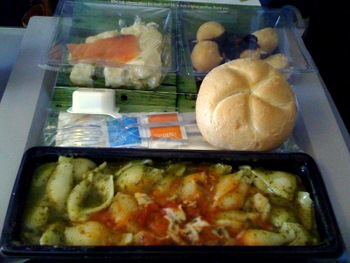
How to Eat Food on a Plane

If you’ve ever flown, you know that one of the greatest hazards you will face, after crying children, people who blow their noses right next to you, and, of course, snakes, is dealing with airline food.

Oh, not the part about whether it will be edible or not. Airline food has gotten surprisingly better since the days of early air travel when you had to wait to get your lunch until the plane stopped in Cedar Rapids for gas.

No, airline food isn’t a meal at a five-star restaurant or anything, but if you catch the right airline, then you’ll very likely be offered up something that has some aesthetic appeal, comes with a brownie, isn’t bland on the old taste buds, and won’t (immediately) kill you. Given that last, though, and since the choice is also almost always pasta or chicken, go with the pasta. It (almost) certainly won’t kill you. The chicken, on the other hand? Well, chicken is suspicious. Go with the pasta.

However, unless you’re sitting in First Class, once you have your food, you’re faced with a far greater dilemma than whether or not you’re risking salmonella. If you do generally travel First Class, then you’ve got nothing to worry about. Heck, you can even eat the chicken with impunity–not to say that it’s less likely to poison you, but if you can afford First Class, then you can also afford to get your stomach pumped when you get off the plane. Just have your chauffeur spin you on over to the private hospital, then you can get back to your weekend plans with one of the Hilton daughters.

But if you’re anywhere else on the plane, then right after the steward puts your pasta platter on the fold-down tray in front of you, you have to figure out how to eat the bloomin’ stuff.

KLMdinner1-1I mean, it’s right there. You can smell it. You can feel the heat of it rising up off the Saran Wrap-sealed containers. You can certainly see it: there’s the pasta box, there’s the thing with the salad, there’s the roll, there’s the desert, there’s the cheese and the butter and the sealed baggie containing plastic-ware, napkin, and salt-and-pepper packets. But how do you eat it?

The regular way, you say?

You’re crazy. You must fly First Class. No, if you’re in the cattle car section of the plane, you are very likely stuffed into a seat that has your knees crammed up in front of you, pushing up on the tray that’s holding your food and threatening to spill it all onto the floor. On either side of you, there’s probably someone else eying their own platter, and their elbows are almost certainly poking into your ribs. A full range of movement is impossible.

But you can’t very well dip your head down and start slurping. For one thing, you haven’t managed to get the plastic off the containers yet, so the best you’d be able to manage is to push everything around on the tray. Sure, you could start gnawing away at the roll, but how satisfying is one roll?

There is a definite skill involved in eating onboard an aircraft while stuffed into Economy Class. It may require practice at home, but you can do this.

First, and most important, is mastering the elbow tuck. Your seat mates aren’t doing it, so you’re going to have to. Pull those elbows in to your sides so that your forearms and hands stick out straight in front of you, kind of like a T-Rex’s. Your fingers should be hovering above the tray. As a bonus, your arms are now protecting your ribs from the assault of your neighbor’s elbows as they knife-and-fork their way into their chicken. Each time they do so, say, “Rawr, I’m a T-Rex!” This might–probably won’t, but might–earn you some extra space.

At the very least, you now have access. But where to start? At home, you’d go with the salad first, then move on into the main course, followed by the dessert. It’s just the way things are done. But on a plane, convention must be thrown out through the hole in the window you’d better hope isn’t there. Instead, you’ve got to clear away the small stuff so that you’ll have room to work with that bubbly-hot plastic-sealed pasta.

Go for the roll. No unwrapping to do, there, though getting to the napkin and the plastic-ware might be useful at this point and that’ll take some skill. Say, “Rawr” again and tear it open with your teeth. Once you’re ready, butter and cheese up the roll. Throw in some crackers from the salad, if you want. I like to set my roll on top of the pasta box to heat it up some (they usually come out of the serving cart with an internal temperature just slightly above that of that mammoth they found in Russia the other day).

On to the salad.

About that salad. Skip that. Even the best-looking salads I’ve seen on a plane still had brown lettuce in it. Don’t trust the salad…it’s friends with the chicken. You can, however, eat the desert at this point. Whether it’s a brownie, a cookie, or (and this really happened to me once and I recommend KLM because of it) strawberry shortcake, scarf it down now.

At this point, there’ll be a lot of trash: all sorts of plastic-y things that will want to curl up on your tray and make the whole business lack something in the way of appetizingness. If you can get away with it, put this detritus on your neighbor’s tray while he’s busy elbowing someone else and isn’t paying attention. If you can’t get away with it, then I recommend stuffing everything under the salad container. Makes the salad good for something, anyway.

Finally, you’re ready for the main course, which had better by-goolyhammer be pasta. Haven’t you been paying attention? Work the fork-to-mouth action as best you can.

Meal consumed, you can now lean back, elbow the people next to you a few times for fun, and start tossing back your beverage of choice, which, because you’re on a plane, had better be alcoholic (there’s free wine and beer on all KLM flights; I’m going to buy stock in these people).

After that, it’s just a matter of watching a movie or two until the stewards bring around breakfast and you can do the whole thing all over again.

Just, for the love of all that is good and right in the world, don’t have the eggs.

They’ll grow up to be chickens, you know.

Posted in How To, Observation Deck | Tagged , , | 1 Comment

The DC vs Marvel Movie Conundrum

DCsuperherocollageYou may have noticed that there are a lot of superhero movies being made these days. There are probably lots of cultural and societal reasons for that, but that’s a discussion for another time. What I want to talk about is that, while there may be a lot of superhero movies being produced right now, there are even more complaints about those superhero movies.

Oh, the complaints aren’t that the movies are too childish, too fantastical, too removed from the real problems of the world–no, no, none of that. The complaints are that DC can’t seem to get its act together to make a decent movie based on one of its iconic characters. Well, except for Batman. They’ve done quite well with Batman, though that last movie was a little confuddled. The Superman movie got exposed to too much kryptonite, Wonder Woman is somewhere lost in time and space, and the Justice League is stuck in the clubhouse for the foreseeable future.

Meanwhile, the other Big Comic Name, Marvel, has been rolling out great superhero movies one after the other. Spider-man (I, II, and III, plus a reboot with The Amazing Spider-man), Iron Man (I and II), Thor, Captain America, and, of course, last summer’s superpower-level blockbuster, The Avengers.

So, why can Marvel manage it, but DC falls out of the sky?

You can make (and read about) all sorts of arguments: poor management, poor directors, poor scripts, blah blah blah. However, those arguments all miss the biggest bane of DC’s superhero properties. I said it up in the second paragraph: “iconic characters.”

The DC Big Three–Superman, Batman, and Wonder Woman–are staples of American culture. They are so entrenched in the American psyche that even people who have no interest in comics, in superheros, or even in escapism, know who these characters are and probably even something about their backgrounds. And all this, mind you, even before the characters entered the mainstream through TV shows and movies. Before the movies, you could very likely go out to any Midwestern farm, track down a farmer on his tractor, ask him who Superman was, and he could tell you. Same for Batman, and the same–although he might have been more loathe to admit it–for Wonder Woman.

But Iron Man? Who the heck is Iron Man? Some comic book dude made out of iron or something, right? Thor? Never heard of him. Captain America? Maybe. Spider-man? Okay, sure, he probably heard of Spider-man. I’m not saying this line of reasoning is perfect. However, Spider-man was always second tier to the Big Three: Superman, Batman, and Wonder Woman. You probably wouldn’t find Peter Parker having coffee with Clark Kent, even though they’re in the same business–both in and out of costume.

What Marvel was able to do by taking lesser known characters and putting them up on the big screen, was to introduce them to the movie-going public in a fresh way. I read a lot of comic books as a kid, but Iron Man? He seemed boring. But Marvel took the character and made him bigger than he’d ever been in the comics. So big, in fact, that now Iron Man is one of their own iconic properties. So big that if a Marvel movie doesn’t have a Robert Downey Jr (the actor playing the part) cameo in it, then it’s failed on some substantial level.

True, DC succeeded with the Batman franchise. In a way, though, this is because Batman is a lot like the second-tier superheroes of the Marvel universe: he’s fallible. He’s human. He’s just like us, only with more money. We in the audience know that we can’t ever be Superman or Wonder Woman. Those characters were born to their parts, but if we won the lottery, then maybe, just maybe, we could be Batman.

So the other reason that most of the superheroes–at least the ones doing well at the box office–from the Marvel universe are doing well, is that the majority of them are just regular people who have been given extraordinary powers, be that from a spider bite, from the exploitation of high tech, or from super science.

Sure, there’s Thor, but he gets away with it because he’s one of those lesser-known characters I was talking about.

Anyway, given all of this, what can DC hope to do to change their fortunes? It seems obvious: they’ve got to get away from focusing on the Big Three and focus, instead, on their second-tier characters: Flash, the Martian Manhunter, Plastic Man, and, er…Green Lantern.

Okay, maybe it is poor management, bad directing, and terrible writing after all.

If you’d like to see a superclip of every superhero movie ever made, check this out: http://blastr.com/2012/04/epic-supercut-swarms-with.php That’s also where the author found the pic at the top of the page.

Posted in Reviews and Rants | Tagged , , , , , , , , , , , , , , , , | Leave a comment

Words to Action (The Genesis of Lady Starr, Space Ranger)

The Lady Starr, Space Ranger cast performing.

The “Lady Starr, Space Ranger” cast performing Episode #1: “Lady Starr and the Tentacle Monsters of Venus!”.

As an essayist and novelist, most of the words I write on the page stay there, nice and safe and able to be interpreted by me how I meant for them to be interpreted (i.e.: how they sounded in my head when I wrote them down). Other people may read them and interpret them differently, but I won’t know that unless they say something in the comments section. No, they are … safe.

But recently, what started as a side-project of mine — the “Lady Starr, Space Ranger” audio play series — has been teaching me about the dynamism of words.

“Lady Starr” is about an aspiring actress and former Miss Kansas from, erm, Kansas who goes to Hollywood to break into movies, but winds up in the Space Ranger Corp instead, protecting the galaxy from evil and stuff. Okay, that makes it sound all heartwarming and life-affirming. It isn’t. It’s a spoof of those old, pulpy, science-fiction radio plays of the 1930s, 40s and 50s — the Flash Gordons, the Buck Rogers, the Shadows, and so on (such as this 1935 production of Flash Gordon). Lady Starr likes her job, but she isn’t particularly good at it — unless there’s zapping or sword fighting. She’s good at that, but not so good at diplomacy or making meetings on time. And her crew is just as misfitish. There’s her exasperated sidekick, the genetically-modified, cybernetically-upgraded, intelligence-enhanced mollusk (read: snail), Vermicelli. And there’s the mopey, self-conscious, and soul-searching Speaker Phone, propagator of all things exposition-y.

Plus a lot of bad guys — many of whom have tentacles.

I started writing the series for a friend of mine who wanted something to fill some time on a radio program she was involved with. That fell through, mostly because the Lady Starr episodes I wrote were too long and — as far as I could tell — didn’t have enough references to bodily functions.

But in a fluke of serendipity (hmmm, if it’s “serendipity”, can it be a fluke? Discuss), I happened to mention the project to a local producer who also happened to be staging a series of dramatic readings (and humorous re-invention and improvisation) of the original Star Trek series. He was primed for interest in an original retro-pulp story like Starr’s AND he’d just been approached by a radio station to provide some programming.

So I started working on more scripts and he started working on all the other stuff: getting actors, liasoning with the radio station, and so on and so forth and so such and such.

George Cron works behind-the-scenes on the production of "The Adventures of Lady Starr"

Our producer, George Cron, working behind-the-scenes on an episode of “The Adventures of Lady Starr, Space Ranger.”

To glaze over this next part, well, that didn’t work out. The deal with the radio station fell through and our first recording was lost to the aether. I was out of the country at the time and hadn’t been able to make it to the first recording sessions, but had been told they’d gone quite well.

There we were. But I had the “pilot” season finished, writing-wise (five, 20-ish minute-long episodes), so we decided to just record the thing ourselves and put it out there and see what happened.

Plagues of technical difficulties followed, along with losing some of the original voice actors due to, y’know, life. But we persevered, despite having to completely re-tape the first episode no fewer than three times and having to do all of this with the most basic of gear and studio space (a couple of mics, a computer, and a back bedroom in the producer’s house).

But I got to be a part of that, since I had returned from my trip by then. And that’s where we get to the oddity of hearing your words come out of other people’s mouths, interpreted sometimes in ways that you the writer might never have expected.

I sit in on the recording sessions as head writer, of course, making changes on the fly to the script as needed (and depending on how tongue-twistingly I wrote some of the original dialogue) and serving as informal behind-the-scenes videographer and still photographer.

But sooo strange. Inflections, pitches, intonations — all were subtly or vastly different than those of the voices in my head (which I should probably take something for, but don’t. Heh).

The voice actors were pulling the words off the page and making them into something else, something new, and something (hopefully) compelling to our (hopefully) vast, future audience.

Here’s a sample. These two characters, Bob and Phil, were originally throw-away characters used to pitch products in one of the show’s fake advertisement bits. But when I was writing, they just kept pushing their way back into the script. Here, Bob and Phil are scientists on Titan working on sentient pizza toppings and trying to sell their product to a pizza-loving galaxy. Keep in mind, too, that this isn’t how the final audio will sound; it’s behind-the-scenes, after all. Enjoy:

Not what I’d heard in my head, which wasn’t quite as over-the-top. This was better.

“The Adventures of Lady Starr, Space Ranger” is a shoestring production, so help us out by following us on Facebook (Lady Starr, Space Ranger) and Twitter @SpaceRangerHQ  and, when post-production is done and the season is up on iTunes, have a listen, and enjoy the action of the words taking you to a place far away and very silly.

Posted in Creativity, How To | Tagged , , , , , , , , , , , , | Leave a comment