Warbling

First, they invented bison hunting. We know this because there are pictures of it painted on cave walls in France. Also on bathroom stalls in Detroit. Right after the invention of bison-hunting, though, the boys were milling around the fire, bellies full of bison steaks, when they realized that they had a problem: they had no idea what to do to unwind after a long day of chasing bison with long sticks.

That’s when they invented karaoke.

Actually, the invention of karaoke went something like this (Picture a smoky bar. Somewhere in the background someone drops a whole tray of glasses, but that’s not important to the story. What is important is that someone else has just started to sing. We join our heroes, already deep in discussion):

“Awww, man, what is that, somebody singing “Danny Boy” again?”

“Yeah, man, somebody’s always singing that song in this bar. Brings me down, man.”

It was the 70s, so you’ll have to excuse the speech patterns of our heros.

“Yeah, man, me too. If they’re going to sing, man, they should sing something different, man.”

“Yeah, man. You know what’d be cool? Man, like, some kind of tv that showed the lyrics to songs so you could sing along with ’em without having to remember the lines. Man.”

“Oh, man! Man! Yeah, man! That’s cool, man! Man, let’s do it. Let’s make that!”

“Man!”

Actually-actually (this time I really mean it), karaoke was a creation of the ever ingenious Japanese, who did indeed invent it back in the 70s. According to all the volumes of the Encyclopedia Britannica that I’ve shoved into my computer, it all started in Kobe, Japan. Japanese businessmen, in between watching episodes of “Hello Kitty” on bar televisions and watching scantily-clad Taiwanese girls lip-synching renditions of “Purple Haze,” liked to get up on stage themselves and belt out their own interpretations of various popular songs of the day.

Eventually, the Japanese decided to make a machine so that the businessmen might at least have the option of reading along with the lyrics, even if they chose not to. Said machine would come with a little video monitor that would display the lyrics of the clientele’s mostest favoritist songs. The machine would also come with a microphone and an amplifier.

Some might argue that the amplifier was not, strictly, necessary.

Because, let’s face it, most people who get up in front of a karaoke machine to sing aren’t the ones who would win “American Idol” competitions … or even talent shows at the local high school. The word “karaoke” does, after all, mean “empty orchestra.” If you’ve cleared the orchestra out, the audience probably isn’t that far behind.

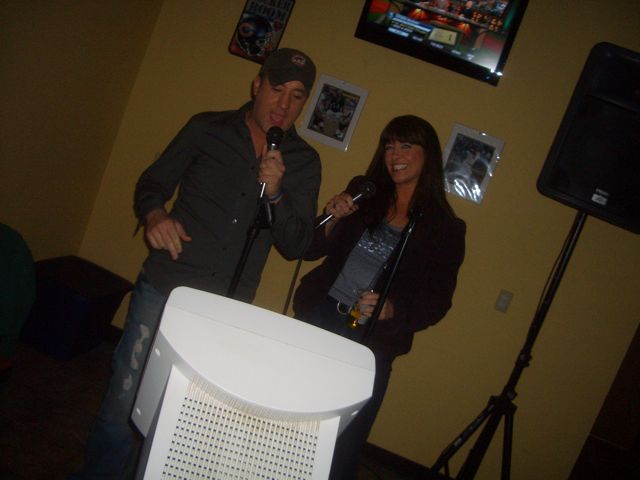
Karaoke duet

The obligatory karaoke duet.

This is not to say that there aren’t a few particularly good karaoke singers. Not long ago, I went to karaoke night at a bar with a group of friends. There wasn’t a stage, but the dance floor had been cleared so that the karaoke machine and all of its attendant wiring could be set up (such a small machine; so much wiring). Pretty soon (getting the first karaokers revved up for karaoke-ing usually requires a pitcher or two of something frothy), there were a few singers. As it turned out, one of them was really good and could very easily have been on “American Idol.”

Then again, Clay Aiken won on “American Idol,” so I might not be using the most accurate means of measurement.

Anyway, during the rest of the evening, we were able to determine that most of the rest of us sucked. Had I tried my rendition of Julio Iglesias’ “To All the Girls I’ve Loved Before” (wherein I replace the word “girls” with “sheep” — just for fun, mind you, not because I was born in sheep country … though I was), I’m pretty sure that windows would have shattered and someone would have had to dial 911.

Despite this, and surprisingly, we had a great deal of fun.

Also surprisingly, no one sang “Danny Boy.” Thanks to the Japanese, we now finally have something to do after a hard day of hunting bison.
*
The author would like to note that the singers in the photos accompanying this column did not cause serious harm to any of the other patrons with their singing skills. Everyone survived and there was only minor hearing loss.

Posted in Observation Deck | Tagged | 2 Comments

The Day of Debacles

Part One: The First Debacle–The Negotiation

The Day of Debacles began when we tried to get a driver for the day, although we wouldn’t find out that the debacle had begun for a while yet. I’ll also admit that this first part of the Day of Debacles was my fault.

You see, a friend and I were in Panama City, wanting to go to central Panama, where there was a volcanic crater known as El Valle. My companion’s guide book said that there was beautiful scenery; a small, scenic town; a zoo; a spa; a waterfall; and horseback rides up into the high slopes above the valley (it was a very large volcano). My companion — we’ll call him John, since that was his name — was all about the spa. He’d been looking for the Perfect Massage for several days, talking about it even before we got to Panama City. The Perfect Massage apparently consisted of the following:

1). Deep-muscle kneading.

2). Said deep-muscle kneading achieved by having the masseuse stand on one’s back.

3). No hookers.

John was quite adamant about #3, to the point where, given the language barrier, I was pretty sure that the people John asked about places to get a massage (everyone) thought that we were looking for a brothel. Overseas, the word “no” tends to get lost in translation when the word “hooker” is also in the sentence. “We definitely, absolutely, positively do NOT want a massage parlor that is really just a brothel” becomes “Brothel? Where good at?”

John was primarily concerned about this last point because, according to him, hookers gave really terrible massages.

However, none of that had anything to do with the First Debacle. That came about because there was a crowd of drivers vying for our attention, none of whom spoke English, and because between John and me, I was the one who could speak the better Spanish, despite the fact that it had been seven years since I had spoken anything close to passable Spanish.

We were hoping to hire a car and a driver for about eighty bucks for the day, based on John’s previous experiences in Panama.

“We need a car and a driver,” we said in English.

“Need car?” they said in English. “He drive.” There is then pointing involved.

“Yes, a car,” I said in Spanish. “Driver. All day. How much?”

Consultations. Frowns.

“Where go?”

“El Valle.”

“Oh! El Valle very nice. You like. Very far.” Some of this in English, some in Spanish.

“How much?”

Consultation. Some rolled eyes. More pointing.

Really, the rolled eyes should have been a warning to us. The guy who was being fostered upon us was older, lined of face, grizzled of hair, and scraggly of beard. His clothes hung off of his skinny frame.

“Doscientos,” he said. “Todo.”

Turning aside to John, I said, “He wants a hundred for the day. Total.” A hundred was a bit more than we’d been planning, but apparently El Valley was three hours from Panama City, farther than we expected.

Here’s the problem:

If you know any Spanish at all, you know that ‘dos’ means ‘two.’ It’s definitely not ‘one,’ and when it’s put in front of ‘cientos,’ it doesn’t mean “one hundred”; it means … TWO hundred.

My bad.

Golden Tree Frog

One of the endangered golden tree frogs of Panama.

Part Two: The Second Debacle–The Noble Stallions of the Valley

Once upon a time, the horses of El Valle — a wide valley in central Panama created by the collapse of an ancient volcanic caldera — may have been the finest of their breed. They may have pranced proudly upon the greenways of the valley, carrying intrepid tourist-adventurers hither and yon and yon and hither and so and forth. Their minders may have been of proud Mayan stock, quick of wit and honorable of intention.

Now?

Not so much.

True, we were running late. We’d already eaten sea bass at a quaint little restaurant in a quaint little hotel in a quaint little town. We had gone tourist gew-gaw shopping. And we’d spent a great deal of time at the zoo, where we had seen the rare, endangered golden tree frog of Panama and lost my traveling companion, John, for fifteen or twenty minutes. For a while, our tour guide (the cab driver) and I were convinced that John had wandered off into the rainforest and gotten eaten by a wild boar, or possibly a mountain goat. Later, he showed up. He had indeed wandered off into the rainforest, but nothing had eaten him.

Doesn’t make for a very good story, if you don’t get eaten when you wander off. I made sure to let John know how it was supposed to work — for future reference, of course.

Anyway, there we were, finally, at the horse rental place. In Panama, at least in El Valle, a horse rental place isn’t anything like the Hertz Car Rental place at the airport. In fact, the horse rental place in El Valle was a shady spot under a tree. Said horses were tied up to said tree, looking angry.

How can a horse look angry while standing in the shade?

It was in their eyes. In … their … eyes.

Angry Horse

He's contemplating the terrible things he can do to us.

Our tour guide (El Cab Driver) had brought us to this place, assuring us over and over that yes, indeed, the horses would take us up into the mountains so that we could look out over the valley. Yes, indeed, the horses would take us by El Valle’s famous waterfall. Yes, indeed, the horses would take us to the spa where my traveling companion could finally get his massage from a woman who would walk on his back and who was not a hooker. Plus, they would do this in the three hours we had before we needed to start back to Panama City, three hours away by car.

How’d he know? Well, he and his wife had been here ten years earlier. They’d gotten a really good deal on the horses, too.

“Don’t let them charge you more than $8 per hour, total,” he told us.

After fifteen minutes of arguing with the proprietor of the horse riding establishment, we settled for $10 each per hour, or something like that. I was never quite sure how that argument ended, but then I was the guy who had thought we were paying $100 for a cab ride and a driver for the day when in fact it was $200.

Then we had to deal with the horses.

Once, perhaps (as previously noted) these horses might have been warriors’ steeds. Now, though, they were swaybacked, dirty, tired, sullen, mean, single-minded (the single mind the urge to return to their shady spot under the tree where they could look angry in peace), somewhat mangy, ill-mannered nags.

When we finally got them on the road, we found that they only had two gears: trot, which is the horse riding equivalent of taking your four-wheel-drive Jeep out into the Arizona Badlands and driving it around blindfolded; and Let’s-stop-and-eat-grass-by-the-side-of-the-road.

Our guide (not the cab driver) wasn’t much better. He spoke no English, and apparently no Spanish. He just rode behind us on his much-better-behaved horse switching at ours occasionally with a leafy branch in order to get our horses to move at a trot (as opposed to a nice, friendly ‘walk’ or a speedy-but-relatively-comfortable ‘canter’ or even a hair-raising-but-at-least-not-painful ‘gallop’).

Thinking that we were going to be riding on trails through the mountains, we instead found ourselves riding on roads in the quaint village we’d just been in. We were able point to the quaint restaurant in the quaint hotel, the quaint shops with the quaint tourist gew-gaws, and the quaint road leading to the quaint zoo … all while the locals paused to point at us, the quaint tourists, and giggle.

Finally, though, we made it to the waterfall. At least now we would be able to take the horses out on nice, SOFT, mountain trails. But it wasn’t to be.

The waterfall was right beside the road. We could have driven there in five minutes instead of subjecting ourselves to an hour of torture on horseback.

Then we turned around and went down another road to the spa.

Which was closed.

El Valle de Anton Market

The market in the El Valle de Anton town of Anton.

Part Three: The Third Debacle–The Cab

After a day spent in central Panama enjoying things such as a hundred-foot-high waterfall pounding down through a rainforest canopy and a lovely lunch of sea bass in salsa served with fried plantains, we were finally leaving the ancient volcanic caldera called El Valle, with its spectacular vistas, its quaint … everything … and its surly horses.

In only three hours, we would be back in Panama City in time for supper.

However, at this point the theme song for “Gilligan’s Island” started playing in my head (“A three -hour cruise / a three-hour cruise”) along with all of those castaways-on-a-deserted-island connotations.

The sun was setting over the ridge surrounding El Valle, and this was the car we were about to drive three hours in:

1). The driver’s side door got stuck once in such a way that the driver had to climb over me, in the backseat, to get up into the front.

2). The rearview mirror was broken and almost completely useless, except for one sliver of silver that was somehow hanging on. Which rearview mirror? Yes.

3). Every red light that could possibly be lit up on the dashboard, signaling an impending emergency, was lit.

4). It was only after the first three miles, heading up out of El Valle, that the driver realized he had left the parking brake on. Yes, that was the source of the burning brake pad smell.

5). Every window in the car was tinted. Not just a little tinted, but a LOT tinted. Not just some of the windows, ALL of the windows, including the front one.

6). The front headlights were dim, dirty, and misaligned.

7). Fact #6, combined with fact #6, meant that once night fell, the driver couldn’t see anything in front of the vehicle without sticking his head out the window like a wind-hungry Labrador.

At least he was upbeat about all of this. “Not used to this car,” he said. “My regular car is in the shop.”

A chop shop, maybe?

And then, “It is hard to see. Funny, yes?” No. “Once we get to the highway, there will be lots of other cars. We will use their light to see by.”

It started to rain.

He was at least correct in that there was plenty of traffic on the highway, most of which he then set about trying to hit, since he still couldn’t see anything through the heavily-tinted windows. Luckily, the other cars were able to see us and most of them dodged out of the way in time.

Okay, okay, ALL of them dodged out of the way in time, but there were a few close calls, a lot of honking, and at least one very, very scary semi.

My only condolence in all of this was that I was in the backseat. I figured that I had a fifty-fifty chance of surviving any given smashup.

Meanwhile, in the front, my traveling buddy, John, kept up a banter with the the driver about the possibilities of finding a massage parlor where he could have someone who wasn’t a hooker step on his back.

The driver just kept trying to peer through the windshield from three inches away, as if that would help.

Finally, though, the rain stopped and we drove in to Panama City, where the street lamps were at least bright enough that we could see the edges of the road, if not the actual lanes marked on the asphalt.

Then we had to pay the cabbie the $200 I had accidentally agreed to earlier.

And John still didn’t find his brothel … er, massage parlor.

Posted in Observation Deck | Tagged , , , , | 2 Comments

A Howler Monkey in the Bush is Worth Two Birds on a Branch

“Look, there’s a crab right there,” my hiking companion said.

“Where?”

“Under the leaf.”

“Dude,” I said with some exasperation, “we’re in a jungle; there’re leaves everywhere.”

Technically it wasn’t a jungle; it was a rainforest. Well, according to the guide, it wasn’t a rain forest so much as it was a “humid” forest. Still, it seemed jungle-like to me. There were palm trees; there were mimosas; there were tangled roots everywhere; and there were certainly leaves: big leaves, little leaves, medium-sized leaves; leaves that were dried and curled, leaves that were still green and damp from the previous day’s rains; leaves that were being chopped up by leafcutter ants and carried across the trail in industrious little lines. What I didn’t see was the crab. Of course, I also couldn’t see most of the birds that everybody else was seeing, either. This part rather defeated the purpose, since that’s why we were on the Pipeline Trail in the first place: for bird watching.

We had traveled twenty miles from Panama City to get to the Pipeline Trail and its humid-or-at-least-slightly-more-than-moist forest. All the way, the road we had been on flanked the Panama Canal, that mosquito friendly transportation artery connecting the Caribbean to the Pacific. Massive cargo ships snailed their way along the Canal, sharing the space with Navy ships from a variety of countries, pleasure yachts from a variety of millionaires, and fishing boats from a variety of local guys who wore ratty shirts and, from what I’d heard, snazzy white fedoras.

The Pipeline Trail had originally been constructed to provide the U.S. Army with a means of mobilizing and moving troops quickly along the length of the Canal. It was never used for that purpose and eventually fell into disrepair. When the Panamanians took over the old Army base and turned it into a resort hotel (Gamboa Resort), they also decided to turn the Pipeline into a trail. Ten miles of it has been reclaimed so far. It’s known as the best birding in Central America: a place where you can sometimes see 250 species of birds in a morning of birdwatching.

Birding Guide

Our guide spots some birds through his super-scope.

Mind you, the key word there is “morning,” so of course we were there in the afternoon.

Also, with apologies to my grandfather and his collection of bird books, bird watching has always ranked up there for me at about the excitement level of televised bowling and the spirited activities associated with raising pet rocks.

I’ll admit that this opinion is influenced by my chronic inability to see whatever it happens to be that I’m looking for: arrowheads, mushrooms, birds, the remote, meaning in the “career” of Paris Hilton … whatever. My companions would be pointing out things (“There’s a duck-billed pheasant-feathered Norwegian-German brush hawk right there on that limb. Don’t you see it?”) and all I’d see was a branch. Half the time, even when the guide set up his 7 million x birding scope, all I’d see was a branch.

Finally, though, we came across some birds too big for even me to miss: toucans. Yup, just like in that old cereal commercial, where Toucan Sam hawked (that’s a pun, folks) multi-colored loops of fruit. These toucans didn’t talk, but they looked roughly the same: vibrantly-colored beaks, bright plumage, tiny little safari jackets. Okay, maybe those weren’t safari jackets; might have been photographer’s vests. Same idea, though.

A toucan in a tree

A toucan observes the author observing him.

Shortly after the toucans, a group of white-faced monkeys leaped from limb to limb through the treetops, much like birds, though one was crossing the trail carrying her baby on her back. Then we saw an anteater and another flock of toucans. Wildlife galore.

A monkey with her baby.

A monkey crosses the trail while carrying her baby on her back.

As we were crossing a bridge over a small stream, there came echoing through the forest a long, low sound that built up in volume until it mimicked that moment right before a car wreck, when everyone’s brakes are moaning and tires are trying to grip the asphalt.

“What’s that?” I asked quietly. The nature of the sound induced a sort of library-like quietude in the forest. It was a haunted sound, a foreboding sound.

“Howler monkeys,” the guide said.

We couldn’t see them, but the sound went on and on for several minutes.

It’s possible that they were upset because they couldn’t spot the crab under the leaf.

Posted in Observation Deck | 1 Comment