Rewound (October Horror #5)

[The month of October is prime season for horror movies, and the author has been examining the sub-genres of horror films. This is the final installment of that series … in much the same way that “Final Destination” was the final film in that franchise.]

A few days ago I saw “Fright Night” (2011), which is a remake of the 1985 classic. This one didn’t have Roddy McDowell in it and it wasn’t a spoof of vampire and horror movies like the first one was, but it did still have a share of humor and, let’s admit it, much better production values and acting. It also had David Tennant in the Roddy McDowell role. As a Doctor Who junkie, I’m obligated to like anything with David Tennant in it.

“Fright Night” is one of the rare horror remakes that actually turned out as good or better than the original. There are a few like that. “Dawn of the Dead” (2004) doesn’t do the social commentary quite as well as the 1978 original, but it’s still a good zombie yarn and it looks pretty. Well, except for the zombies, of course. “Piranha” (2010) is another one. It goes for over-the-top nudity and gore and plays up the spoofiness, giving it a distinct advantage over the 1978 “Jaws” rip-off. And I’m also very hopeful about the new “Don’t Be Afraid of the Dark” (2011). The 1970s original scared me as a kid; I’m hoping that the remake manages to do the same to me as an adult.

There’s also “The Fly” (1986), which was a remake of a 1958 horror (in the bad way; not the, y’know, good way), and the 1982 Kurt Russell “The Thing,” that bested the good-but-dated 1951 “Thing from Another World” version.

There are also a number of foreign-language-to-English-horror-movie remakes that should be included in any list of successful re-dos: “The Ring” (2002), “Let Me In” (2010), and even “The Grudge” (2004) all take the difficult-to-approach foreign versions and make them accessible to a broader American audience, although I’ll argue that “Let the Right One In”, the 2008 Swedish progenitor of the English-language “Let Me In” is the better movie. It’s worth reading the subtitles so that you can appreciate the Scandinavian imagery.

But there are so many bad remakes that the good ones are eclipsed. Although the 1984 “Nightmare on Elm Street” lost something over the years as we moviegoers came to expect slicker and slicker production values, the new version failed to capture the menace and the sheer creepiness of the original. When, in the Robert Englund version, Nancy looks up from her desk to see her dead friend at the door of the classroom, encased in that opaque body bag, it’s just … scary. The remake, even with its shot-by-shot scene swipe, doesn’t manage to replicate that nightmare-inducing imagery.

Tom Welling in the remake of the beautiful, menacing, atmospherically-drenched 1978 John Carpenter-directed “The Fog”? Puhleeese. Sorry about any breakout hopes you might have had, Mr. Welling, but stay in Smallville.

There’s also a new “Thing” out. I’ve heard it’s terrible. There’s also maybe possibly going to be an “Evil Dead” (1981) re-do. No thanks. Give me Bruce Campbell overacting in the original any day over a non-campy version.

Then there’s the 2007 Rob Zombie “Halloween” remakes and its sequels. Not bad in and of themselves, they would make fine splatter-slasher movies if only they weren’t “Halloween” flicks. The 1978 original (I’m sensing a trend here — 1978 appears to have been a fine year for horror) had its share of bloodiness — as one of the original slasher movies (along with “Friday the 13th” (1980), itself remade in 2007 for the new age of teeny-boppers, but at least offering an explanation for how Jason can be everywhere at once. Spoiler: tunnels under Camp Crystal Lake), “Halloween” was derided at the time for its violence, but Rob Zombie eschews menacing atmosphere for slash after slash after slash. Feel free to like that sort of thing.

Speaking of movies that Jared Padalecki (of TV’s excellent “Supernatural” series) stars in, other than the “Friday the 13th” remake, he was also in the “House of Wax” (1953/2005) do-over along with Paris Hilton. So that tells you all you need to know about how good that was. His “Supernatural” co-star, Jensen Ackles, was in his own remake: 2009’s cover of the 1981 “My Bloody Valentine.”

Oh, and let’s not forget Stephen King’s 1997 mini-series remake of the absolutely terrifying “The Shining.” King has said that he always hated the 1980 Stanley Kubrick version. Sometimes Stephen King is wrong, really, really wrong.

I’m not opposed to remakes. A friend of mine (here’s his blog) once argued that film actors shouldn’t be denied the opportunity to play beloved characters from previously filmed movies any more than stage actors are, or any more than musicians are when they cover a previously recorded song. I don’t disagree. Still, there is a permanence about films that isn’t replicated in stage productions, or even musical compositions. Stage plays are expected to change (sometimes a little, sometimes a lot) from night to night, show to show. Plus, stage plays are ephemeral: they remain only in the memory, and the only way to for anyone to see them again or for the first time is to go see a new production of them (unless they’re filmed, of course, but at that point they become something else). We expect those actors to be replaced by new ones; we expect new directors to come up with new interpretations of the materials. Songs are this way too, to an extent, explaining the popularity of the concert, of the stage performance. Films, on the other hand, come with a sense of immutability. If there’s a very good version already, then one is forced to wonder why we should try for another one. Sure, there’s a chance that the remake will be just as good (or better) and will add to the collective creative excellence of the cinematic world. There’s an even better chance that it will fall short, and in doing so, possibly lower the value of the original, associating a taint to the original that wasn’t there before (sequels can cause this result even more often than remakes. Can you say “Highlander II”?).

All in all, unless you’re calling a do-over on a previously horrible movie (“The Hills Have Eyes,” most Hammer films), then maybe it should be left well enough alone.

But if David Tennant wants to do any more remakes? Hey, I’m all for it.

Posted in October Horror Thread, Reviews and Rants, Themed Threads | Tagged , , , , , , , , , , , , , , , , , , , , , , , | Leave a comment

Giant Spider Crafts

[Note, this article is on how to make a giant spider, NOT a discourse on the arts-and-crafts skills of giant spiders, although I’m sure their birdhouses are perfectly lovely.]

So you want a giant spider for Halloween, do you? But you don’t want to spend $40 on one from the Halloween Store. Well, you’ve come to the right place. I make a new one every Halloween and it only costs me about sixty cents. Here’s what you’ll need:

* Two (2) black trash bags (I buy the cheapo roll from the local grocery store)

* Two (2) twisty ties. The trash bags should come with those.

* One (1) newspaper (local or international — either is fine)

* One (1) roll of duct (or ‘duck’ or ‘electrical’) tape; or a half dozen (6) thumb tacks — or all of the above

Paper or plastic? You'll need both for this project

The things you'll need.

Construction: Wad up a couple of pages of newspaper and shove it down into the bottom of one of the trash bags. This will be the spider’s ‘head.’ Tie this section off with one of the twisty ties. With more (or less) newspaper, you can make this section as large or small as you want. I recommend that it be about 1/3 or 1/4 of the trash bag.

Right now, it's just an oddly-colored ghost

Tying off the 'head.'

Proceed to filling the remaining section (the ‘abdomen’ of the spider) with wadded up pages of paper. DON’T PACK THE PAPER TOO TIGHTLY — you want the paper to provide shape, but the more pages you use, the heavier the spider will be and the harder it’ll be to hang on the wall. Go for light.

When the abdomen is fluffed out, tie it off with your remaining twisty tie. Set the ‘body’ aside; it’s time to work on the legs.

Sorry about the background

Here's the finished 'body' of the spider.

Taking the second trash bag, cut or tear it (I often can’t find my scissors) down either side until you reach the bottom seam. This will give you a long, roughly rectangular sheet of plastic. Tear or cut 8, 1-inch-wide strips off of the sheet, making the strips as long as you can.The width and length don’t need to be laser accurate, but you want the strips wide enough they won’t tear in the wind if you mount the spider outside. The longer the better, since these legs will be what really makes the spider look spider-y.

Fun, right?

The finished legs.

Assembly: Figure out where you want to put your spider. I mount mine on the porch of my house, but of course any wall surface will do (feel free to mount it on the floor or the ceiling or a convenient tree if you want to and can figure out how — it’s your spider, after all).

Ahhh! Get the bug spray!

The finished spider.

Keeping your spider on the surface you’ve prepared for it is the hardest part of this whole business. I use duct tape augmented with thumbtacks for the body. I usually put the tape on the abdomen section in about the middle, then plaster it on the wall. I use the thumbtack to keep the tape from peeling up from the weight of the spider’s body. If the head isn’t angled right (i.e.: it looks like a spider with a broken neck), you can put some more tape there to provide shape (the head is usually light enough that a piece of rolled tape stuck to the back of the head is enough to hold it in place).

Now for the legs. As I said above, the legs are what makes the spider look spider-like. Depending on where you’re placing the spider, you can either attach the legs directly to the body, or to the surface under the body. I prefer the latter; that way, if the body falls down because of weight or weather, the legs aren’t pulled down with it. It’s a lot easier to stick the body back up than it is to re-engineer the legs.

Anyway, the legs go onto the base surface outward from the body and then bend at the ‘joint’ — about a third or halfway down the length. I like to do 90-degree joints for the middle four legs and 45-degree joints for the front and back sets of legs. You can adjust these to your preference and for the surface you’re attaching them too. I use tape to secure the legs to the base surface.

Optionally, you can add webbing, eyes (cut out of white paper and taped to the head), and/or anything else your imagination desires.

Voila! A giant spider that didn’t cost a lot. You can use that extra money to buy grasshoppers to feed your tarantula.

I'm glad the windows are locked

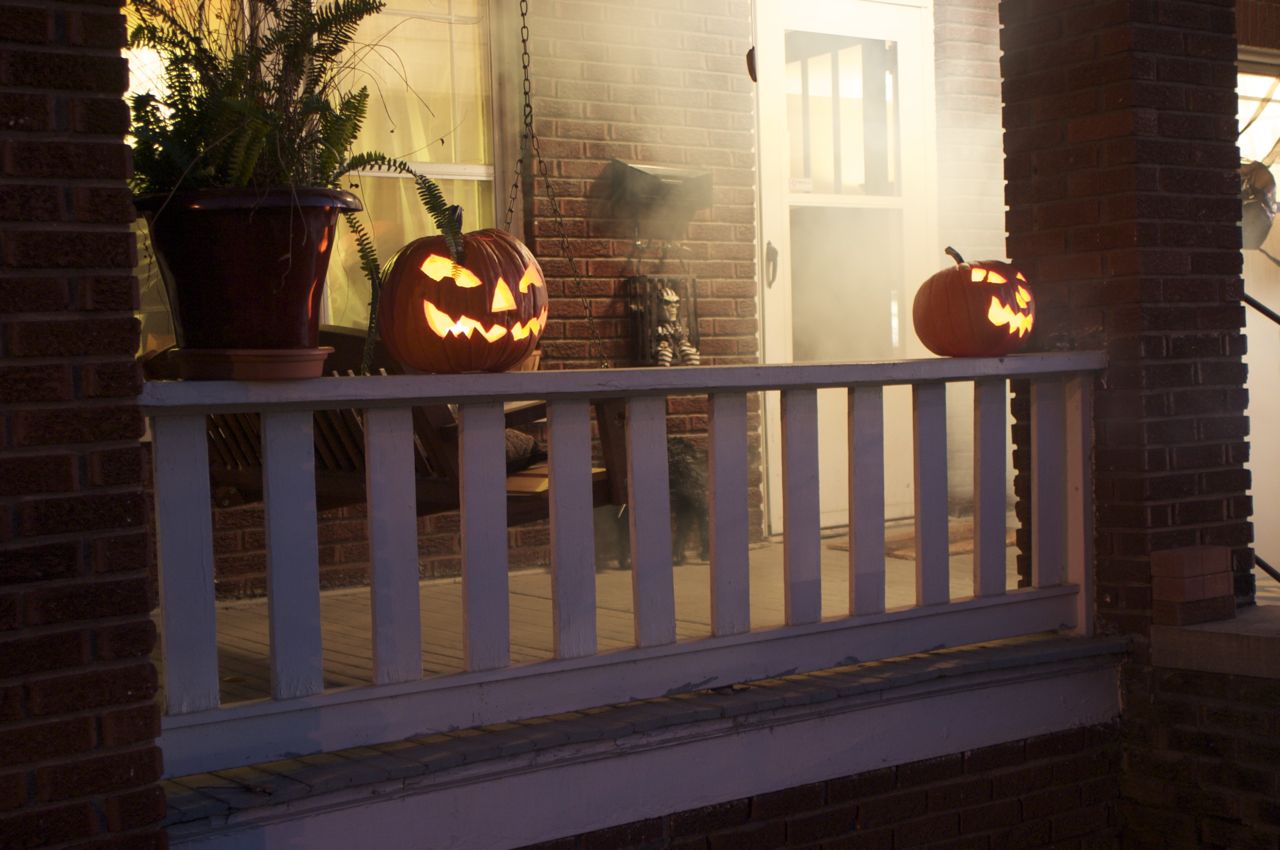
The completed giant spider, mounted on my porch.


Posted in How To | Tagged , , , , | 1 Comment

Houses of Horror (October Horror #4)

[The author has been spending the month of October delving into the nature of horror-themed stuff, mostly movies. This is the fourth in the series]

Boo!

Beware the houses you find in the woods; you never know what might be lurking within.

At last we’ve gotten around to talking about haunted house movies. This is, perhaps, my favorite horror movie genre and has been from the time I read the “Amityville Horror” as a kid and then saw the movie in 1979. The buzzing flies that congregated on the window; the blood dripping down the walls; the glowing eyes of the demonic pig as it peered into the child’s bedroom from the darkness outside the house — these are the things of nightmares, and nightmares are why we watch horror movies, right? At least, they’re why I watch horror movies: I like to be scared.

For me, there’s very little scarier than finding that your home — your refuge, the place where you are supposed to feel the most safe — has been overtaken by the ‘other’, whatever that ‘other’ happens to be. In “The Amityville Horror” the ‘other’ is supernatural, which is my personal favorite. A human evil has to find some physical way into the house, as with “Them” (2007) or “Panic Room” (2002) or any number of other psychos-have-just-gotten-into-the-house movies. Often this is scary and creepy and I’m not trying to downplay the horror of “Them” or of what may be the ultimate intruder-in-the-house movie, “When a Stranger Calls” (1979), based on the urban legend of the Babysitter and the Man Upstairs (http://www.snopes.com/horrors/madmen/babysit.asp), but the denizens of the supernatural dark don’t need a door; they just need the dark.

Although there are many horror movie tropes — there must be strange noises; things must move or open or appear or disappear at random; things must be seen out of the corner of the eye before they are seen straight on; there must be some false positives (the cat jumping out of the closet) and some false negatives (“Oh, that must have been the cat jumping out of the closet” — there are only two primary kinds of haunted house stories.

The first is where a family moves into a new place — often purchased (or rented) at a ridiculously low rate — and then discovers, to their dismay, that the place is already occupied by something … else. The something else could be the creeping creatures with their grasping hands of 2011’s “Don’t Be Afraid of the Dark” (and it’s me-scarying-silly 1970s progenitor of the same name) or Wes Craven’s “People Under the Stairs” (1991), or the thing-that-goes-bump-in-the-night “Boogeyman” (2005). Alternatively, the something else could be the shifting shapes and psychological tricks of ghosts and demons as in the above-mentioned “Amityville Horror,” 198s’s “Poltergeist” (“Get out of the house!”), “Burnt Offerings” (1976), 2001’s “13 Ghosts” (2001) (where the ghosts can only be seen through special goggles (creeeepy)), or the endlessly entertaining “Paranormal Activity” movies (2007, 2010, 2011 — previously discussed here).

Of course, there’s also Stephen King’s “The Shining” (the 1980 Stanley Kubrick version, not the 1997 mini-series). In all of moviedom, there may not be any more frightening scene in horror than that of young Danny Torrence cycling his Power Wheels around a corner in the hotel only to see those dead, twin girls standing there.

To offset that image, I have to go to the William Katt starrer “House” (1986) which allows me to laugh, jump, and be concerned about whether or not I have a transdimensional portal hiding behind the wallpaper all at once.

Aside from “The Shining”, perhaps two of the best — certainly the most haunting, heh heh heh — of this kind of haunted house movie are the movies-with-a-twist “The Others” (2001), which plays with the haunted house tropes in clever ways, and M. Night Shyamalan’s “The Sixth Sense” (1999). In this latter, I know what the twist is (heck, I knew it ten minutes into the movie) and it still give me shivers. I get even more shivers during the scene where Haley Joel Osment is hiding under his sheet fort with his flashlight and when the fort collapses we see that there are now two forms outlined beneath it.

Okay, okay, if you know your horror movies, then you may be saying to yourself, “Hey, that’s not right. Haley Joel Osment could see dead people, which we know ’cause it says so on all those funny-mocky t-shirts. Didn’t matter where he was or what house he was in. Oh, and while we’re on it, the same goes for “Paranormal Activity.” Those daughters were being stalked; didn’t matter where they lived.”

Yup, you’re right. Absolutely. But there were houses involved. And those houses were spooky. So there.

Anyway, the second kind of haunted house movie (we’ll call it Type II) is the staple of teen-scream horror flicks: some group of people, be they investigators, good-looking twenty-something teens looking for a dare or a scare, or unfortunates who just happen to be in the wrong place (a house) at the wrong time (usually night), find themselves doing their best to keep their blood inside their bodies, where it belongs, as well as their sanity.

Paranormal investigations (of the not “Paranormal Activity” found-footage kind) have been popular in the history of haunted house movies. Investigations provide the filmmakers with reasons the characters would be in the obviously scary places they’re in, rather than running away, which would be the far wiser choice. The granddaddy of these is 1963’s “The Haunting,” based on “The Haunting of Hill House” by Shirley Jackson. The original is better than the 1999 Catherine Zeta Jones starrer of the same name. Interestingly in the original vs remake ring, I like the 1999 “House on Haunted Hill” better than the 1959 Vincent Price original. Well, unless you count the 2009 Rifftrax version of the latter. Mind you, the protagonists in “House on Haunted Hill” aren’t investigators. They’re there because they want to win money for staying overnight in a ridiculously-haunted house.

To get back to our daring investigators, we have to look to 1973’s “The Legend of Hell House”, and Stephen King’s “1408” (2007), wherein a cynical paranormal investigator, played by John Cusack, must last the night (heck, an hour — a very long hour) in a haunted hotel room — we’ll say that a haunted hotel room counts as a haunted house, just like the Nostromo does in “Alien,” with the alien of the title playing the role of ‘haunt’ (we discussed that move here).

Another Stephen King haunted house movie involving paranormal investigators is the mini-series “Rose Red,” which pays homage (a LOT of homage) to “The Haunting of Hill House”, but is still worth watching, as it takes the time to develop the themes. As does 2011’s non-investigator Type I horror tv series “American Horror Story.”

Dares are another good way to get characters to go places they wouldn’t otherwise go — then the doors and windows can lock and they’re trapped in there with the creaking floors, the mysterious things seen out of the corner of eyes, and the very angry spirits. Strangely, although I know that there are a bunch of movies that use this trope (the first episode of “American Horror Story” used this, too), all I can think of for an example is “Monster House,” so if you’ve got a few stuck in your head, let me know in the comments section.

Finally, there’s the wrong-place/wrong-time set. That pretty much covers all of the above, but sometimes you’re just not where it’s good to be, like in the best horror movie ever!, 2005’s “House of Wax,” where the good-looking twenty-something teens stumble on a town made of waxworks. Unfortunately, that’s a slasher flick and doesn’t really fit the Haunted House motif.

Oh, why is it the best movie ever even though it has a horrible plot and the acting sucks? Paris Hilton is impaled on rebar. You just don’t get better than that in a movie. Any movie.

But a very good movie that you’ve probably never heard of that does fit the sub-sub-genre is “Dead Birds” (2005), a horror-western (yes, I wrote that line — “The Burrowers” is another good horror-western, but it doesn’t work in the haunted house category). In it, some bank robbers take refuge in a house out in the middle of nowhere. Bad things ensue.

Until next time, when we examine all the leftovers, remakes, and shiny, bloody things, plug a movie into the brain-sucker box, pop some popcorn, and dim the lights.

And don’t worry about that noise coming from the attic. I’m sure it was just the cat.

Even though you don’t have a cat.

Posted in October Horror Thread, Reviews and Rants, Themed Threads | Tagged , , , , , , , , , , , , , , , , , , , , , , , , , , , , , | Leave a comment